

Investors tend to approach robotics investing by searching for the single breakout name. But automation resists that logic. It is a deep, interconnected ecosystem spanning hardware, software, sensing, and precision components, and value is distributed across every layer of that stack.
 The market opportunity is unambiguous. Industrial control and factory automation is projected to grow from approximately $275 billion in 2025 to $435 billion by 2030 a compound annual growth rate (CAGR) of roughly 9.6%.1
Multiple forces are converging to sustain that trajectory: labor-market constraints, the reshoring of manufacturing capacity, the maturation of AI-driven control systems, and the expansion of automation into sectors well beyond traditional heavy industry. In the automation economy, the infrastructure layer often captures more durable value than the application layer above it.
Against this backdrop, the ROBO Global Robotics & Automation ETF (ROBO) seeks to provide a strategic approach to investing in robotics and automation. Rather than concentrating exposure in a handful of headline names, ROBO spans approximately 80 holdings across the full automation value chain, from industrial leaders to the enabling technologies without which no robot moves, sees, or decides.2
Five Companies Powering the Stack
Understanding where value accrues in the automation ecosystem requires looking at what each company does and why its role becomes more critical as adoption scales.
LAYER 1 — MOTION & CONTROL
|
Fanuc Corporation Industrial robotics & CNC systems |
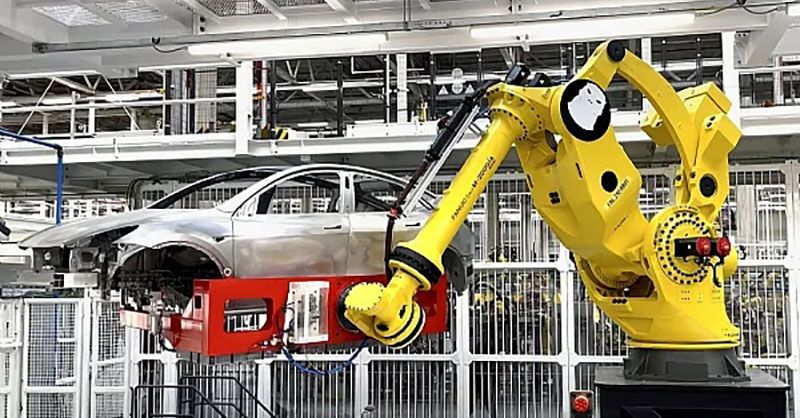
Fanuc is the world’s largest maker of industrial robots and a dominant producer In practice, Fanuc robots weld vehicle frames on automotive assembly lines, paint car bodies, and handle the kitting of complex parts in logistics warehouses. Their CRX collaborative robot line works alongside human operators without safety caging, opening automation to smaller manufacturers who previously couldn’t |
|
Rockwell Automation Industrial software & control systems |
Rockwell is the largest pure-play industrial automation company globally, connecting the physical and digital layers of manufacturing through its FactoryTalk software platform, programmable logic controllers (PLCs), and motion control hardware. Where Fanuc automates individual tasks, Rockwell orchestrates entire production environments. A food and beverage producer, for instance, might use Rockwell’s PLCs to control every conveyor, valve, and mixing station across a facility, while its FactoryTalk analytics software monitors real-time output, flags deviations, and routes maintenance alerts all from a single dashboard. As manufacturers pursue digital transformation and AI-driven production, Rockwell sits at the intersection of operational technology and enterprise software, a position with powerful switching costs once embedded.5 |
LAYER 2 — VISION & SENSING
|
Cognex Corporation Machine vision systems |
Cognex builds the “eyes” of automated systems - camera-based vision hardware and software that allows machines to inspect, identify, and guide the handling of parts in real time. With over 4.5 million systems installed worldwide, Cognex is the dominant player in industrial machine vision.6 On an EV battery assembly line, Cognex vision systems scan electrode films for microscopic defects invisible to the human eye, verify the correct placement of hundreds of components, and read barcodes to maintain traceability across every unit. In logistics, their DataMan barcode readers track every package through an automated fulfillment center. The insight: every robot deployed in a factory or warehouse typically requires one or more vision systems, making Cognex a volume story tied directly to the pace of automation adoption.7 |
|
Keyence Corporation Precision sensors & measurement |
Keyence is the instrumentation layer of the automation stack. The Japan-based company supplies over 350,000 customers globally with laser displacement sensors, 3D profilers, vision sensors, and measurement systems that monitor and guide manufacturing processes at the micron level - tolerances that are utterly impractical to achieve manually.8 In automotive manufacturing, Keyence laser profilers measure door gap and flush simultaneously across vehicle bodies as they move down the assembly line, detecting deviations in real time before a defect reaches final assembly. In semiconductor fabrication, their confocal displacement sensors measure wafer etching depth at nanometer accuracy.9 What makes Keyence strategically interesting is its direct-sales model: its engineers visit customers on-site, embedding the company’s products and expertise directly into production workflows in a way that creates durable, high-switching-cost relationships.8 |
LAYER 3 — ENABLING COMPONENTS
|
IPG Photonics High-power fiber lasers |
IPG Photonics invented the high-power fiber laser in 1990 and remains the world’s leading producer. Fiber lasers have displaced traditional mechanical and gas-based cutting and welding tools across manufacturing, offering higher energy efficiency, greater precision, and lower maintenance requirements.10 The practical applications span nearly every industrial sector: IPG’s lasers weld the structural components of EV battery trays, cut turbine blades for aerospace, scribe semiconductor wafers, and mark serial numbers on medical devices. Welding is IPG’s largest single application. E-mobility which encompasses EV battery manufacturing, accounted for more than 20% of total revenue at its peak, driven by demand from the U.S., Japan, and South Korea.11 IPG supplies turnkey laser systems to automotive manufacturers and their integrators, making it a direct beneficiary of the broader electrification and automation capital expenditure cycle. |
The Compounding Logic of the Stack
What makes this ecosystem compelling as an investment framework is that the layers reinforce each other. Every new Fanuc robot deployed requires a Cognex vision system to guide it, Keyence sensors to verify its output, Rockwell software to integrate it into the production workflow, and IPG lasers to cut or weld the materials it handles. Demand at the system level generates cascading demand across the stack.
Each of these layers is generative rather than merely supportive. As robot deployments scale globally, the demand for sensors, vision systems, and precision components scales proportionally. These are recurring, embedded relationships woven into the production architectures of the world’s largest manufacturers and that recurring nature matters.
The strategic insight for investors is structural: single-company concentration in robotics may expose you to product cycles, competitive displacement, and geographic concentration risk. The ROBO approach is designed to capture the broad expansion of the sector while no single holding dominates the outcome. The top position currently represents just over 2% of the fund.3
The investment thesis centers on owning the infrastructure layer of a structural, decade-long transformation. Sensors go into every robot. Vision systems validate every production run. Photonics cut and weld every assembly.
Automation is a layer of the global economy being rebuilt from the ground up. ROBO is structured to own that rebuild across every layer.
SOURCES:
1 MarketsandMarkets. “Industrial Control & Factory Automation Market Worth $435.24 Billion by 2030.” PR Newswire, January 12, 2026.
2 Motley Fool. “How to Buy Robo Global Robotics & Automation Index ETF (ROBO).” Accessed April 2026.
3 Stock Analysis. “ROBO Holdings List – ROBO Global Robotics & Automation Index ETF.” Accessed April 2026.
4 FANUC Corporation. “Total Shipment of 1 Million Units of FANUC Robot.” News Release, September 15, 2023.
5 PitchBook / Morningstar. “Rockwell Automation 2025 Company Profile.” Accessed April 2026.
6 Cognex Corporation. “Machine Vision.” Product page, accessed April 2026.
7 Cognex Corporation. Form 8-K, Q3 2023. U.S. Securities and Exchange Commission. https://www.sec.gov/Archives/edgar/data/0000851205/000115752323000715/a53392890ex99_1.htm
8 Wikipedia. “Keyence.” Accessed April 2026. https://en.wikipedia.org/wiki/Keyence
9 Keyence Corporation. “Measurement Sensors for the Semiconductor Industry.”
10 IPG Photonics Corporation. “About IPG Innovation.”
11 IPG Photonics Corporation. Form DEF 14A, FY2024. U.S. Securities and Exchange Commission.
For current holdings click HERE. Holdings subject to change.


Carefully consider the Funds' investment objectives, risk factors, charges and expenses before investing. This and additional information can be found in the Fund’s prospectus and Summary Prospectus, which may be obtained by visiting https://cabanaetfs.com/investor-materials. Read the prospectus and Summary Prospectus carefully before investing
Foreside Fund Services, LLC, distributor.
Investing involves risk, including possible loss of principal. There is no guarantee the Funds will meet or maintain their objective. To the extent the Funds investments are concentrated in or have significant exposure to a particular issuer, sector, industry or asset class, the Funds may be more vulnerable to adverse events affecting these groups than if the Funds investments were more broadly diversified.
On June 25, 2025, the names of the Funds have changed from Cabana Target Leading Sector Moderate ETF to ETC Cabana Target Leading Sector Moderate ETF; Cabana Target Drawdown 10 ETF to ETC Cabana Target Drawdown 10 ETF; and Cabana Target Beta ETF to ETC Cabana Target Beta ETF.
The Funds rely heavily on CARA, a proprietary model developed by the Sub-Adviser, as well as data and information supplied by third parties. To the extent the model does not perform as intended, the Funds strategy may not be successfully implemented and the Fund may lose value. The Sub-Adviser’s judgments about the markets, the economy, or companies may not anticipate actual market movements, economic conditions or company performance, and these judgments may affect the return on your investment. In addition, although the Sub-Adviser seeks to manage volatility within the Funds portfolio, there is no guarantee that the Sub-Adviser will be successful.
Commodity-related companies may subject the ETFs to greater volatility than investments in traditional securities. Investments in foreign securities may involve risks such as social and political instability, market illiquidity, exchange-rate fluctuations, a high level of volatility and limited regulation. Investing in emerging markets involves different and greater risks.
New funds have limited operating histories for investors to evaluate and new and smaller funds may not attract sufficient assets to achieve investment and trading efficiencies.
Target drawdown refers to the maximum amount an investment in the fund is expected to fall from peak to trough. Identified target drawdown percentages are targets, not guarantees.
Alpha – the measure of an asset’s performance relative to its benchmark.
Beta – Measures the sensitivity of an investment to the movement of its benchmark. A beta higher than 1.0 indicates the investment has been more volatile than the benchmark and a beta of less than 1.0 indicates that the investment has been less volatile than the benchmark.
Correlation – A statistical measure of how two securities move in relation to one another.
Shares are bought and sold at market price (closing price) not net asset value (NAV) and are not individually redeemed from the Fund. Market returns are based on the official closing price from the Exchange and do not represent the the return you would receive if you traded at other times. NAV (net asset value) is the dollar value of a single share, based on the value of the underlying assets of the fund minus its liabilities, divided by the number of shares outstanding, which is calculated at the end of each business day.
Investment advisory services are provided by Cabana LLC, an SEC registered investment adviser. The firm only transacts business in states where it is properly registered or is excluded or exempted from registration requirements. Registration as an investment adviser is not an endorsement of the firm by securities regulators and does not mean the adviser has achieved a specific level of skill or ability. Additional information regarding Cabana LLC including its fees, can be found in Cabana’s Form ADV, Part 2. A copy of which is available upon request or online at www.adviserinfo.sec.gov. Cabana LLC claims compliance with the Global Investment Performance Standards (GIPS®). To receive the firm’s Independent Verifier’s Report send your request to info@thecabanagroup.com. GIPS® is a registered trademark of CFA Institute. CFA Institute does not endorse or promote this organization, nor does it warrant the accuracy or quality of the content contained herein.